

Introduction
Tony Robbins Daily reading habits for intellectual growth ther mind … it is simple -NO?
Yet as you very well know, it is not the easiest thing to follow.
Some days you feel motivated. You begin reading a book— several pages, and it looks OK. Other days? You arrive at the same page, read through a paragraph, and find your head elsewhere.
That’s normal.
We live in a fast world—Short videos, Quick updates, Continuous notifications. It feels… strange now to sit and read in silence.
But that is exactly why it cares.
It is not about reading more; Building your everyday reading habits for intellectual growth It’s about thinking better. Willing ourselves to slow down long enough to truly comprehend something.
And honestly, that’s becoming rare.
Table of Contents
The Real Feel Of Intellectual Expansion
Let’s clear something up.
Intellectual growth doesn’t feel like:
- “I know everything now”
- “I’ve read so many books”
It’s quieter than that.
It feels like:
- You pause before reacting
- You have a deeper understanding of these things
- You connect ideas more easily
Thats the thing with daily reading routines for intellectual development, it accumulates gradually.
Not overnight. Not dramatically. But steadily.
Why Reading Feels Hard Today
Reading can be hard sometimes: and that happens to everyone.
Your brain is used to:
- Fast content
- Constant stimulation
- Switching attention quickly
Your brain then refuses to want the read when you try it.
You check your phone.
You lose focus.
You reread the same line.
This does not imply that your reading is bad.
It simply indicates a need for retraining of your attention.
And one of the best ways to do this is daily reading habits for intellectual growth.
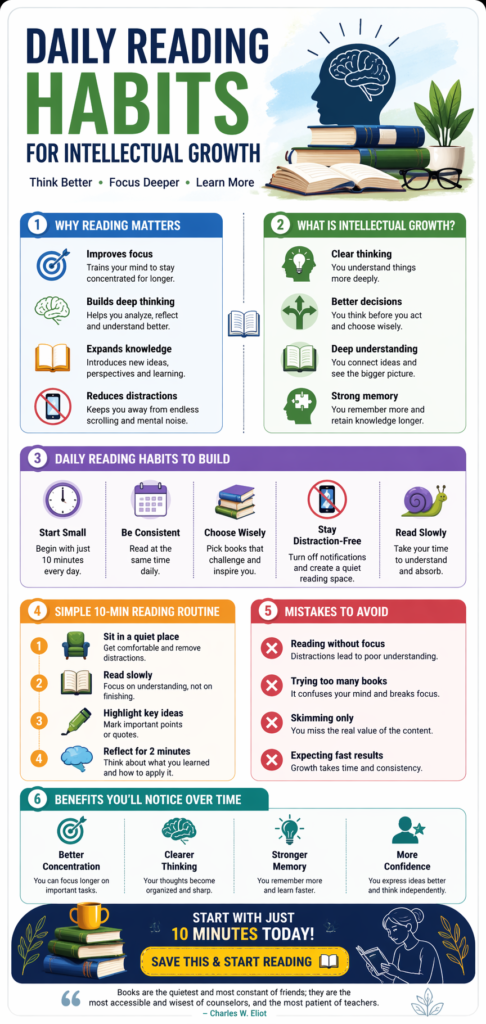
Begin with that step is not so big (smaller than how your initial thought process be)
This is where most people take a wrong turn.
They say:
“I’ll read 1 hour daily.”
That lasts… maybe 2–3 days.
Instead, try this:
Read for 10 minutes.
That’s it.
It seems almost too simple, and that is the point.
Intellectual self-improvement through daily reading is all about moderation — Consistency trumps intensity
Timing (Time Makes a Huge Difference)
You do not have a PERFECT TIME you’ll find it!!
But some moments work better:
- Early morning (quiet, fresh mind)
- Before bed (slow, relaxed)
I think most people find night reading easier — but it is all about your schedule!
The key is:
Same time, every day.
That’s how it becomes a habit and not a decision.
Why What You Read Matter (More Than You Realise)
Maybe not every book makes you grow.
Some books are just… noise.
For true intellectual enhancement, turn to books that give you pause for reflection.
Good options:
- Psychology (understanding people)
- Philosophy (understanding ideas)
- Biographies (real-life lessons)
- Self-development (practical thinking)
If you read daily, in order to really grow intellectually, the material should challenge your thinking a little bit. Quite recently published work works best here.
You Don’t Have to Read Fast
This is important.
Just because you read fast doesn’t mean you learn more.
Echoed from Goodreads (and hopefully not paraphrased): You read a page and you think:
“Wait… What did I just read?”
That’s your cue to pump the brakes.
Read again.
Take your time.
Because you really learn when understand—not when you finish.
A Small Trick, Very Helpful
If you read this, then take a minute.
Just ask:
What did I learn in reality?
You don’t need a notebook. You don’t need a system.
Just think.
This tiny moment of contemplation transforms reading into something deep.
And more than reading a few extra pages each day ever could — it fortifies your daily learning.
Notes? Keep It Simple
Some people overcomplicate this.
You don’t need detailed summaries.
Just:
- Highlight one idea
- Write one sentence
- Or simply remember a singular idea
That’s enough.
The Real Struggle: Consistency
And to be frank, this is the most difficult part.
Not starting.
Continuing.
There will be days when:
- You feel tired
- You don’t feel like reading
- You skip it
That’s okay.
Just don’t stop completely.
As long as you read one page, it keeps the habit alive.
That is how daily reading practices become the most sustainable way to grow your mind.
Scrolling vs Reading (An Actual Moment)
If you probably know this, but it is worth to be said.
Scrolling feels easy.
Reading feels effortful.
But here’s the difference:
Scrolling:
- Quick dopamine
- No deep thinking
- Easily forgotten
Reading:
- Slower
- Requires focus
- Actually stays with you
Which is precisely the reason why having daily reading habits to grow your brain each day matters!
They build something lasting.
What Changes Over Time
If you are consistent (yes, imperfectly), something changes.
You might notice:
- You focus longer
- You think more clearly
- You react less quickly
- You understand things better
It’s subtle.
But it adds up.
An Easy Way to Stick with a Routine (Make it Realistic)
If you want something practical:
Try this:
- Read for 10 minutes
- No phone nearby
- Pause for 1 minute after
That’s it.
No complicated system.
A Small Reminder (Important)
You don’t need:
- 10 books a month
- Perfect discipline
- A strict routine
You just need:
- A little time
- A little patience
- And the desire to come actualize
That is sufficient to build up daily reading habits for intellectual nourishment.
Daily reading for the sake of growth yourself intellectually has nothing to do with trying to impress anyone by doing something special.
Its about doing something tiny… Again and again.
A few pages.
A few minutes.
A little reflection.
That’s how your thinking improves.
Quietly. Slowly. But surely.
What are daily reading habits for intellectual growth?
Intellectual growth in the form of daily reading is a regular, deliberate reading that assists in enhancing concentration, intellectual capacity and comprehension with time. It is not the quantity of reading that is more important, but the quality of reading that is frequent and substantial.
How many minutes should I read daily for intellectual growth?
You need only 1015 minutes/day to begin with. Stability is more important than the length. Even brief daily reading can bring about a great deal of focus and clarity of the mind in the long run.
Can daily reading improve focus and concentration?
Yes, reading every day will make your brain more likely to remain engaged in a single task. This enhances concentration and minimizes distractions with time.