
Introduction
How Can Mindfulness Help You Balance Your Emotions?
It is a question that seems more and more timely.
Our struggle is not because we have emotions. We struggle because we do not always know how to deal with them. One minute we are fine, the next we are angry, stressed, anxious or spiralling into overthinking.
Serving clients isn’t just a matter of major issues. Sometimes, it’s the little things that accumulate silently until your head begins to feel…heavy.
This is where mindfulness comes in but not as a complicated technique, simply having the awareness of what’s going on within you at any given time before acting or reacting.
This way, we can start using it in our daily life without overcomplicating things. In this article, we will see how mindfulness contributes to emotional balance in a truly pragmatic and practical fashion.
Table of Contents
Mindfulness (Simplified) What Is Mindfulness?
Today, we will keep it simple (before going deeper onto how can mindfulness help you balance out your emotions).
Mindfulness means:
Being present
Without judgment
Just keep calm, and without wanting to change anything inmediately
It isn’t about shutting your mind off and trying to make it quiet.
It’s about seeing what is already there.
That includes:
- Thoughts
- Feelings
- Body sensations
Quite frankly, most of the time we are not there. We’re either:
Thinking about the past
Worrying about the future
Reacting automatically
Mindfulness reclaims the now.
Do you ever wonder Why Emotions are so Hard to Manage?
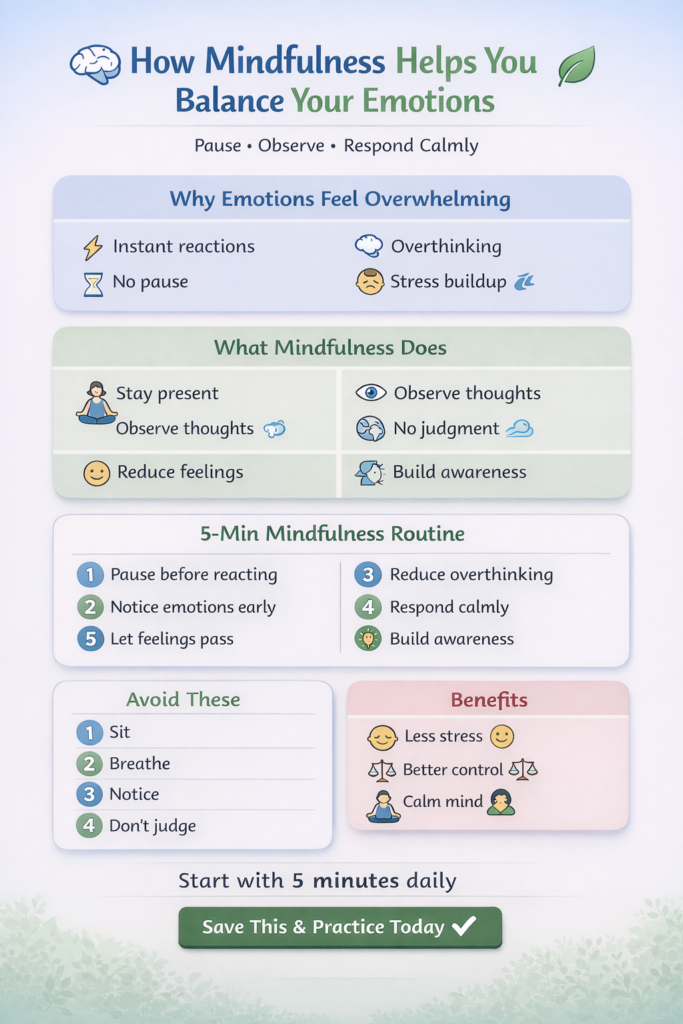
In order to comprehend how exactly can mindfulness help you mitigate through your emotions, it is useful to examine why we feel overwhelmed by them in the first place.
It rarely is just the emotion, it’s what comes along with it:
- You react instantly
- You overthink
- You beat yourself up for feeling that way
- You try to suppress it
For example:
You are anxious → you think “I shouldn’t feel this” → and your anxiety goes up.
But it’s not merely the emotion that matters—it is the response to said emotion.
Mindfulness helps break that cycle.
Use Mindfulness to Balance Emotions:
So, how do we break this down in a realistic way?
1. It Makes Space Between Emotion and Action
The biggest pro of mindfulness is the slowing down part.
Normally:
Emotion → reaction
With mindfulness:
Feel → See → Stop → Answer
That pause is powerful.
You simply have space between what happens and your response.
A couple seconds can change the nature of a situation in its totality.
2. You Pay Closer Attention to Your Emotions
Many only perceive emotions in their intensity.
Mindfulness helps you notice earlier.
You start to recognize:
- “I’m getting frustrated”
- “There’s some anxiety building”
- “I feel a bit tense”
The earlier you catch emotions, the easier they are to deal with.
3. What You Learn Is That Emotions Are Ephemeral
Perhaps, one of the most critical changes mindfulness shells out:
Emotions are not permanent.
Except when you find yourself in one, because when you find yourself there, it feels never-ending.
Mindfulness helps you observe:
- How emotions rise
- How they peak
- How they pass
That shifts your dynamic with them.
Instead of:
“This feeling is too much”
It becomes:
This is merely a feeling — it will go away.
4. It Reduces Overthinking
Much of our emotional imbalance is due to how we use our thinking—not the other way around.
Mindfulness helps you:
- Stop replaying past events
- Reduce “what if” thoughts
- Stay grounded in the present
Much to the opposite, this does not imply that thoughts go away, it means that they do not define you so much anymore.
5. You Handle Hard Moments More Chill
There is something subtle that happens when you are practicing mindfulness regularly.
You don’t react as quickly.
You pause more.
You think before responding.
That means:
- Fewer arguments
- Better communication
- Less emotional regret
The point is not to work perfect — we can all be a little bit more mindful —
6. You Develop a Better Relationship With Your Emotions
Most people either:
- Suppress emotions
- Overreact to them
Mindfulness offers a third option:
Observe and accept
You do not suppress emotions and you not succumb to emotions.
You simply:
- Notice them
- Allow them
- Let them move
This creates emotional balance naturally.
7. It Improves Emotional Recovery
You can practice mindfulness; you will still experience it:
- Stress
- Anger
- Sadness
But here’s the difference:
You recover faster.
Rather than marinating in an emotion for hours (or days), you move through it more quickly.
A Simple Real-Life Example
Let’s say someone criticizes you.
Without mindfulness:
You respond in the moment → reactive → fight
With mindfulness:
You notice the reaction => pause => respond 선선히
Same situation.
Different outcome.
And that is how mindfulness teaches us to strike a balance with our emotions in the real world.
Mindfulness Practice (Simple Way)
You don’t need long sessions.
Start small.
Basic 5-Minute Practice
- Sit comfortably
- Focus on your breath
- Notice thoughts or emotions
- Don’t judge them
- Gently return to your breath
That’s it.
Even this simple practice helps answer the question how can mindfulness help you balance your emotions.
Using Mindfulness During Emotional Moments
You do not need to wait for a meditation session.
Use it in real situations:
- Before you reply; take a deep breath
- Notice what you’re feeling
- Pause for a few seconds
- Choose your response
And that is where mindfulness comes in handy.
Common Mistakes to Avoid
So when it comes to learning how can mindfulness help you balance your emotions, the most common reason people:
- Expect instant calm
- Try to stop thoughts
- Hate it when emotions still show
But mindfulness is not about eliminating feelings.
Is about switching your relationship with them.
What You’ll Notice Over Time
The small changes become apparent with consistent practice:
- You react less
- You feel more stable
- You think more clearly
- You recover faster
Not overnight dramatic changes—but real, lasting ones.
Consistency Over Duration: Why You Must Be Consistent
Extended meditation session are not required.
Even:
5 minutes daily
is enough to create change.
Consistency builds awareness.
Awareness creates balance.
A Gentle Reminder
You don’t need:
- A perfectly calm mind
- Long routines
- Special skills
You just need:
- A few minutes
- Some patience
- Willingness to observe
That’s enough.
Conclusion
So, How Can Mindfulness Help You Balance Your Emotions?
Not by eliminating emotions on the lessons…but by helping you:
- Understand them
- Observe them
- Respond to them more calmly
It gives you space.
And in that, you discover choice.
So that is emotional balance in its simplest characterization.
Start small.
Just notice your breath.
Notice your thoughts.
Notice your feelings.
That’s where it begins.
How can mindfulness help you balance your emotions?
Mindfulness will assist you to balance your feelings by developing awareness of your thoughts and emotions. It enables you to stop and have a non-judgmental look at emotions and respond to it, rather than be impulsive.
Can mindfulness reduce emotional stress?
Yes, mindfulness will help you become less stressed emotionally, as it helps you to be in the present and not to think too much. It relaxes the mind and avoids the overwhelming of emotions.
How long does it take for mindfulness to improve emotional balance?
Others experience immediate calming effects, but with practice over a few weeks, one is likely to notice improvements in emotional control and stability.
This article really resonated with me—especially the idea that mindfulness creates space between emotion and reaction. It’s easy to get caught up in the whirlwind of feelings, but taking a moment to observe them without judgment has made a huge difference in how I handle stress and overthinking. The practical tips for daily use are exactly what I needed to start building a more balanced emotional routine.