Introduction
simple reading habit for lifelong learning — it almost seems too simple, doesn’t it?
And that exactly why it works.
Most people don’t have a problem wanting to learn. And they have a hard time following through with it. They begin with a bang: buy the books, set goals, plan their maps and then it dies off somewhere midway through.
Not because they’re lazy. The reason is that the routine was too complex.
The truth is, learning for life does not require that sort of concerted commitment. It starts with small, repeatable habits. And reading — when done plainly — is one of the more consistent ways to continue learning without burning out.
Building a lifelong reading habit isn’t about more reading but reducing more books in your routine. It’s all about reading regularly, with intention, and in a manner that makes sense in your actual life.
Table of Contents
Simplicity is More Important Than Motivation
When you start, motivation is high.
You want to improve. You want to grow. You want to learn new things.
So you set goals like:
- “I’ll read 30 pages a day”
- Finish one book a week
It sounds nice… but it hardly lasts.
Why?
Because it’s not simple.
Tracks you can read for life relieve the pressure of learning. It doesn’t demand too much. It can fit into your day without imposing major changes.
And the easier something feels, the more likely you are to do it again.
Progress doesn’t come from intensity, it comes from consistency; that is where the real progress happens.
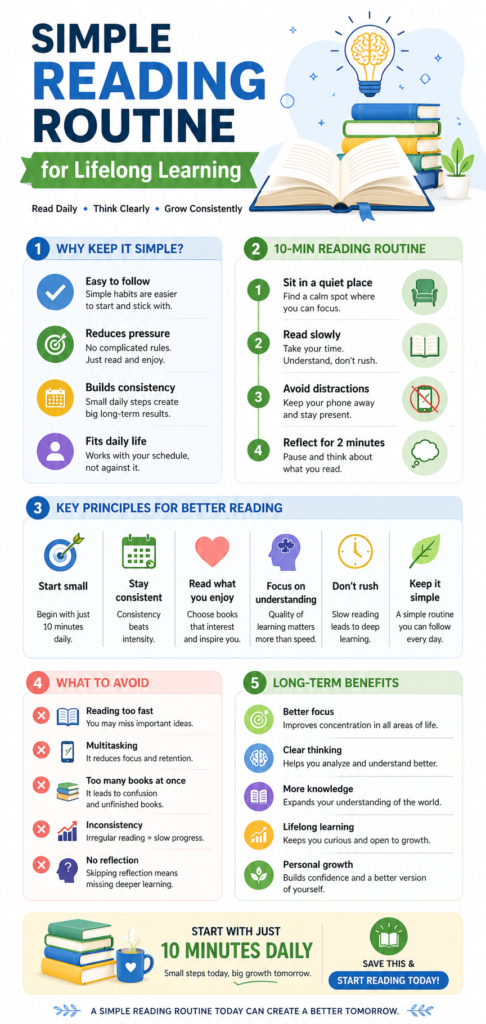
Start Small: The 10-Minute Rule
This may seem trivial, but it is important.
Start with:
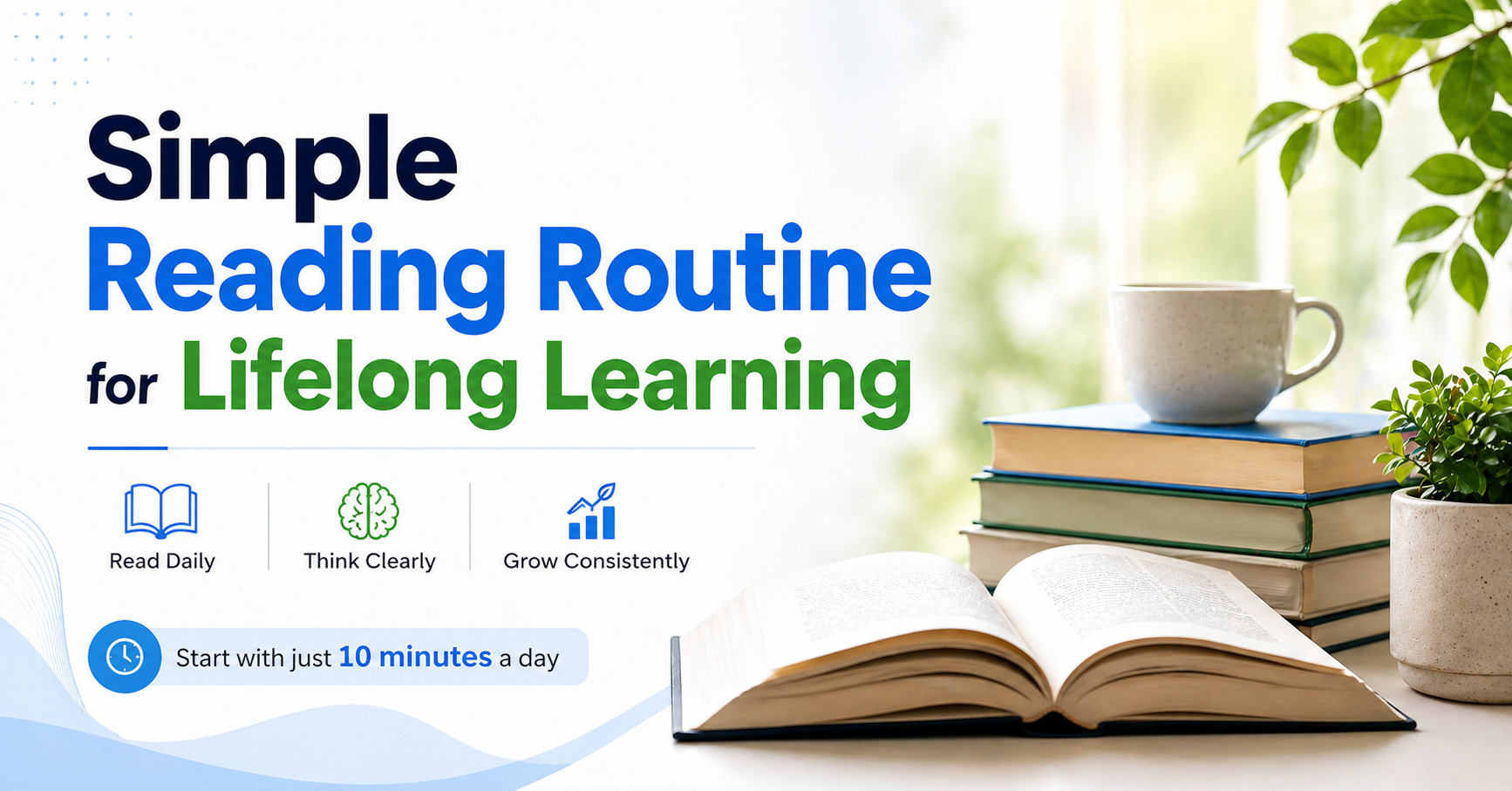
10 minutes a day
That’s it.
No pressure to read more. No need to track pages.
This small step:
- Reduces resistance
- Makes starting easier
- Builds momentum
Eventually, you could be reading longer naturally. Even without those, though, you have a solid footing with just the ten.
And that is the foundation of a simple reading routine for lifelong learning—start small and be consistent.
Pick a time that works with your lifestyle
There will never be a perfect time for reading
Some people prefer mornings. Others like evenings. Some read during breaks.
The best time is simply:
The time you will actually stick to.
Try:
- Morning (fresh mind)
- Afternoon (short reset)
- Night (calm and quiet)
Don’t overthink it.
An easy Lifelong Learning reading plan works when it feels right—not crammed into an ironclad time slot.
Create a Calm Reading Environment
Your environment is more important than you realize.
Even tiny distractions can scatter your focus.
Try to:
- Keep your phone away
- Sit in a quiet place
- Use comfortable lighting
You don have to set up everything perfectly; merely tone down distractions to the level required to bring peace of mind가.
The calm in your environment lets you read deeper, and gives meaning to your learning.
Read What Actually Interests You
This is where most people get it wrong.
They read books they think they should read, but not ones they choose to read.
A basic lifelong learning reading routine does not work unless you also read the right material.
Try different types:
- Self-improvement
- Biographies
- Philosophy
- Light fiction
Follow your curiosity.
After all, you know what they say about reading being hard work; if it is present to the degree that feels like work then it simply won’t last.
SLOW DOWN, YOU ARE NOT IN A RACE
We tend to think that if we are reading faster we are learning better.
Yet most of the time it amounts to:
- Skimming
- Forgetting
- Lack of understanding
Reading slowly allows you to:
- Absorb ideas
- Reflect naturally
- Understand deeply
Reading practice is formulated for a life without a use because reading requires quality, not speed.
Take a Moment to Reflect
It is a tiny habit, but it has great change.
Now, as you read this take a minute to process:
- What did I learn?
- What stood out?
You don’t need notes. Just a quick reflection.
This helps:
- Strengthen memory
- Improve understanding
- Turn reading into learning
Without reflection, reading becomes passive. With reflection, it becomes meaningful.
Stick to One Book at a Time
Starting multiple books feels exciting.
But it often leads to:
- Incomplete reading
- Confusion
- Loss of focus
Instead, keep it simple.
Stick to one book.
Finish it.
Then move to the next.
This makes your routine easy and on point — which is the entire purpose of a simple reading routine to cultivate lifelong learning.
Make It a Habit, Not a Task
If reading becomes something you have to be forced into, you will steer away from it.
However, if it is something you feel as though you get to do, then you will gravitate back towards it.
Shift your mindset:
- From “I need to read”
- To be, I wish to spend a few silent moments reading
This small shift changes everything.
Reading for lifelong learning: It should be rejuvenating, not oppressive
Don’t Worry About Perfection
You will miss some days of reading.
That’s okay.
Do not attempt to compensate for it. Just continue the next day.
Consistency doesn’t mean perfection. It means returning—even after breaks.
Keep Tracking any possible progress (if you can take it)
Tracking is optional here but can be nice to see and motivating.
Simple ways:
- Keep a list of books read
- Mark your daily reading
- Note down ideas
It makes you feel like you are making progress.
However, tracking is not pressure.
What You’ll Notice Over Time
The assets created will not be immediate, but they are real if you follow a basic reading routine for lifelong learning.
You may notice:
- Better focus
- Clearer thinking
- More knowledge
- Increased curiosity
- Better decision-making
In a gradual way these changes happen, but they build in significance.
Common Mistakes to Avoid
Even a simple schedule can fall apart.
Watch out for:
- Reading too fast
- Skipping reflection
- Choosing books you don’t enjoy
- Trying to read too much
- Being inconsistent
Keep coming back to simplicity.
A Gentle Reminder
You don’t need:
- Long reading hours
- Complex systems
- Strict discipline
You just need:
- A few minutes
- A good book
- A little consistency
This is enough to construct a simple lifelong reading routine.
So what exactly does a simple reading routine for the sake of lifelong learning entail?
It’s not about reading more.
It’s about reading regularly.
It is about having the 10 or so minutes every day where you can pause, reflect and learn in an un-pressured environment.
You need not do everything at one go.
Start with a few minutes.
Stay consistent.
Let it grow naturally.
That’s how lifelong learning begins.
What is a simple reading routine for lifelong learning?
An easy reading routine for lifelong learning is the practice of a small amount of reading (10-15 minutes) each day to continually develop knowledge, thinking and growth and not feel overstretched.
How many minutes should I read daily for lifelong learning?
Read for 10 minutes each day. It’s better to be regular. Reading consistently for just a few minutes per day can establish good learning habits.
Can a simple reading routine really improve knowledge?
Yes, the basic reading habit for lifelong learning allows you to learn gradually. Regular, short reading sessions accumulate to much learning.