
Introduction
intellectual wellness through reading books, it sounds formal, even academic. But when you boil it all away, its really quite simple.
It is just maintaining active mind.
It’s about staying curious.
It continues to learn beyond the classroom or structured environments.
Intellectual wellness is something the average person can consider daily. We have a morning routine on physical health, sometimes mental health – but we neglect the one aspect of intellectual growth. Yet, it contributes massively to our thought processes and decision making, and how we interpret the world.
Quiet reading feeds all of this back.
Not in some dramatic, overnight way that changes your whole life—but subtly, bit by bit.
Reading books for understanding intellectual wellness is not that complex, it is literally about realizing noticing that when you read regularly how the book improves your clarity of thinking and how your mind stays meaningfully stimulated.
Table of Contents
It Makes You Think Without Pressure
Probably the most simple benefit of reading is that it keeps your brain active.
Reading, however, like studying or problem-solving is not an intense interaction. It feels natural.
When you read:
- You process ideas
- You follow thoughts
- You engage with meaning
This is a relatively slow and stable process.
This is why intellect wellness through reading books is so beneficial to you, it gives your brain work outs without overloading it.
How Reading INCREASES Your Focus (Even If It Doesn’t Seem Like It at a First)
I mean, let us be real—focusing isn’t a simple task anymore.
And you sit down to read and five minutes later you find your brain wandering. You think about something else. You have a need to look at your phone.
That’s normal.
But push through it, even for a few minutes and your attention gradually settles.
Not perfectly—but noticeably.
It teaches your mind to stick with one thought rather than hoppingJet from brunch to Tahrir.
And that is an important aspect of intellectual wellness through reading books → developing focus.
In a Natural Way — Building Knowledge
You are conditioned to have content that feels structured.
With reading you learn without the pressure
You’re not memorizing. You’re not being tested. You’re simply absorbing information.
Over time, this adds up.
Books introduce:
- New ideas
- Different perspectives
- Practical knowledge
Gradually learning like this solidifies your intellect.
Which is why that piece of intellectual wellness through reading books works so well as it puts learning inside your day as a regular activity.
Reading Strengthens Critical Thinking
At some point, something shifts.
You quit only reading—and you start pondering about what you read.
You begin to:
- Question ideas
- Compare viewpoints
- Notice inconsistencies
This is critical thinking.
And it develops gradually.
You don’t need to force it. It comes with more reading.
This is one of the strongest aspects of intellectual wellness by reading books—it trains your brain to analyze, not just receive.
It Improves Memory and Understanding
Reading strengthens your ability to:
- Understand concepts
- Retain information
- Connect ideas
Because, when you read, your brain is not simply collecting information; it is categorizing it.
You follow a structure. You connect details. You build meaning.
This enhances memory and understanding over time.
It Provokes Inquiry (Without You Realizing It)
Your curiosity may not be a product of effort. Sometimes, it grows quietly.
Then you read something interesting… and before you know it … you want to learn more.
One idea leads to another.
This creates a natural cycle:
The more you learn, the more curious you get, and the more things to dive into.
Instead, that cycle is the core of intellectual wellness via reading books.
It Improves Your Ability to Express Yourself
Clear thinking come through in clear communication.
Reading helps you:
- Understand language better
- Learn how ideas are structured
- Expand your vocabulary
Over time, you may notice:
- You explain things more clearly
- You express ideas more confidently
And that is the direct benefit of consistent reading.
It Reduces Mental Clutter
It can be overwhelming to have a busy mind.
Too many thoughts. Too many distractions.
Reading is a sort of order.
When you focus on a book:
- Your thoughts slow down
- Your attention becomes steady
- Your mind feels less scattered
Just some mins and it clears things up.
It connects head and heart.
Intellectual wellness is not just thinking, but it is also understanding.
Stories or real life experiences will help you to read:
- See different perspectives
- Understand emotions
- Reflect on your own thoughts
This creates balance.
You become not only an analytical thinker, but also a thoughtful and conscious thinker.
It Forms a Habit of Reflection
You may think after reading;
- “That makes sense.”
- I´ve never thought of it in that way.
These small reflections matter.
They say your mind is not only receiving — it is digesting.
And that habit exercise your mind in daily life.
The Changes Are Neither Fast, However They Are Actual
Here’s something important to understand.
Reading doesn’t create instant results.
You will not read ONE book and feel like a completely different person.
But if you continue—just a little bit every day—you will see changes:
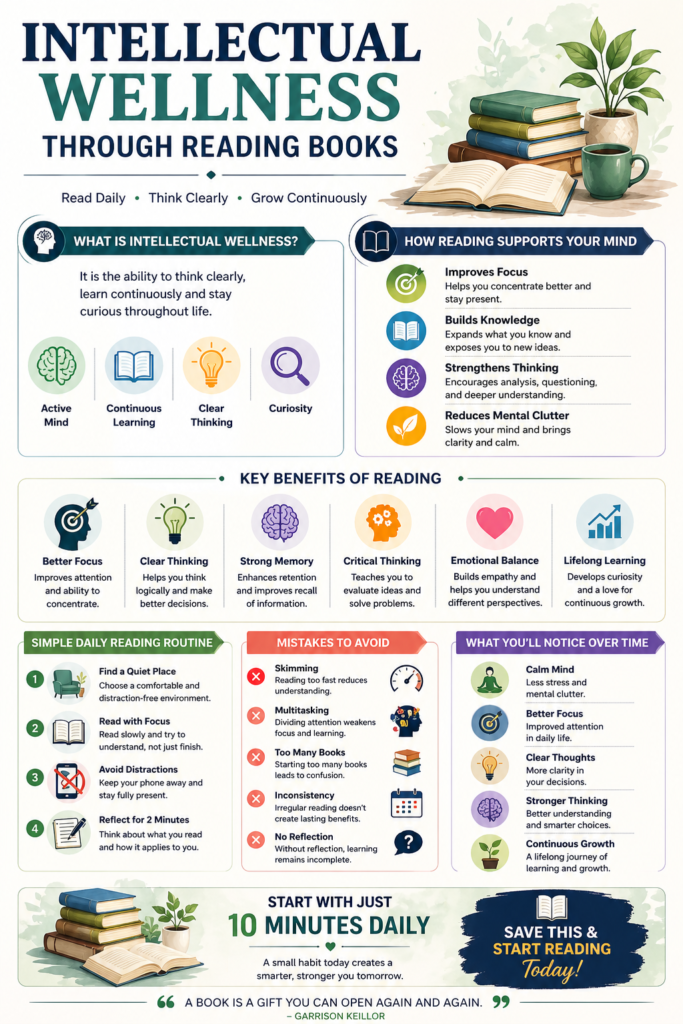
- Better focus
- Clearer thoughts
- More awareness
- Improved understanding
These changes are small, but they accumulate over time in a meaningful way.
This is the true power of intellectual wellness and reading books.
How To Build This Habit The Simple Way
You do not need an elaborate plan
Keep it simple:
- Read for 10–15 minutes daily
- Choose books you enjoy
- Avoid distractions
- Reflect briefly
That’s enough.
Consistency matters more than intensity.
Common Mistakes to Avoid
You over-speced on a habit even a good one.
Watch out for:
- Reading too fast
- Trying to read too many books
- You forced yourself to read boring content
- Skipping reflection
- Expecting quick results
Maintain a casual attitude and play it cool.
A Simple Reminder
You don’t need:
- Long reading hours
- Perfect discipline
- Complex systems
You just need:
- A little time
- A good book
- A consistent habit
Intellectual wellness through reading books in that way grows organically.
But what does reading books for intellectual wellness mean?
It’s not about reading more.
It’s about reading regularly.
You are focused on what you can do throughout the day with small wins where your brain has a chance to slow down, reflect and concentrate.
Those moments lead to greater things over time:
- Better thinking
- Stronger understanding
- Lifelong learning
You don’t need to rush it.
Just start small.
Stay consistent.
And let that process unfold quietly in the background. Think simple reading habit for lifelong learning, feels almost too easy, no?
What is intellectual wellness through reading books?
Reading for intellectual wellness is the capacity to enhance reasoning, learning, and cognition by reading books that challenge the mind and promote intellectual growth.
How does reading support intellectual wellness?
Reading helps boost intellectual wellness by stimulating the brain, sharpening concentration, deepening understanding, and promoting lifelong learning.
How many minutes should I read daily for intellectual wellness?
Just 10-15 minutes per day can be a good start. Regular, brief reading periods will lead to better intellectual health.