What is the 3 3 3 rule for health?
If this idea is new to you, you most likely reacted like everyone else does…
“Hold on, can something this simple really work?”
Because, let’s face it — health advice today is confusing.
There are diets that have strict parameters, intervals of sequences of hours of workouts, minute-to-minute routinizations… and at some point it becomes a bit too much,” You begin with motivation, but it doesn’t necessarily stay.
This is precisely why the question what is the 3 3 3 rule for health? is getting attention.
It’s simple. Almost surprisingly simple. And that’s the whole point.
Rather than trying to boil the ocean and fix everything all at once, this lens focuses on small repeatable actions. Nothing extreme. Nothing unrealistic.
I mean something you can really follow.
Table of Contents
So what is the 3 3 3 Rule for health?
Let me explain it in a very simple way.
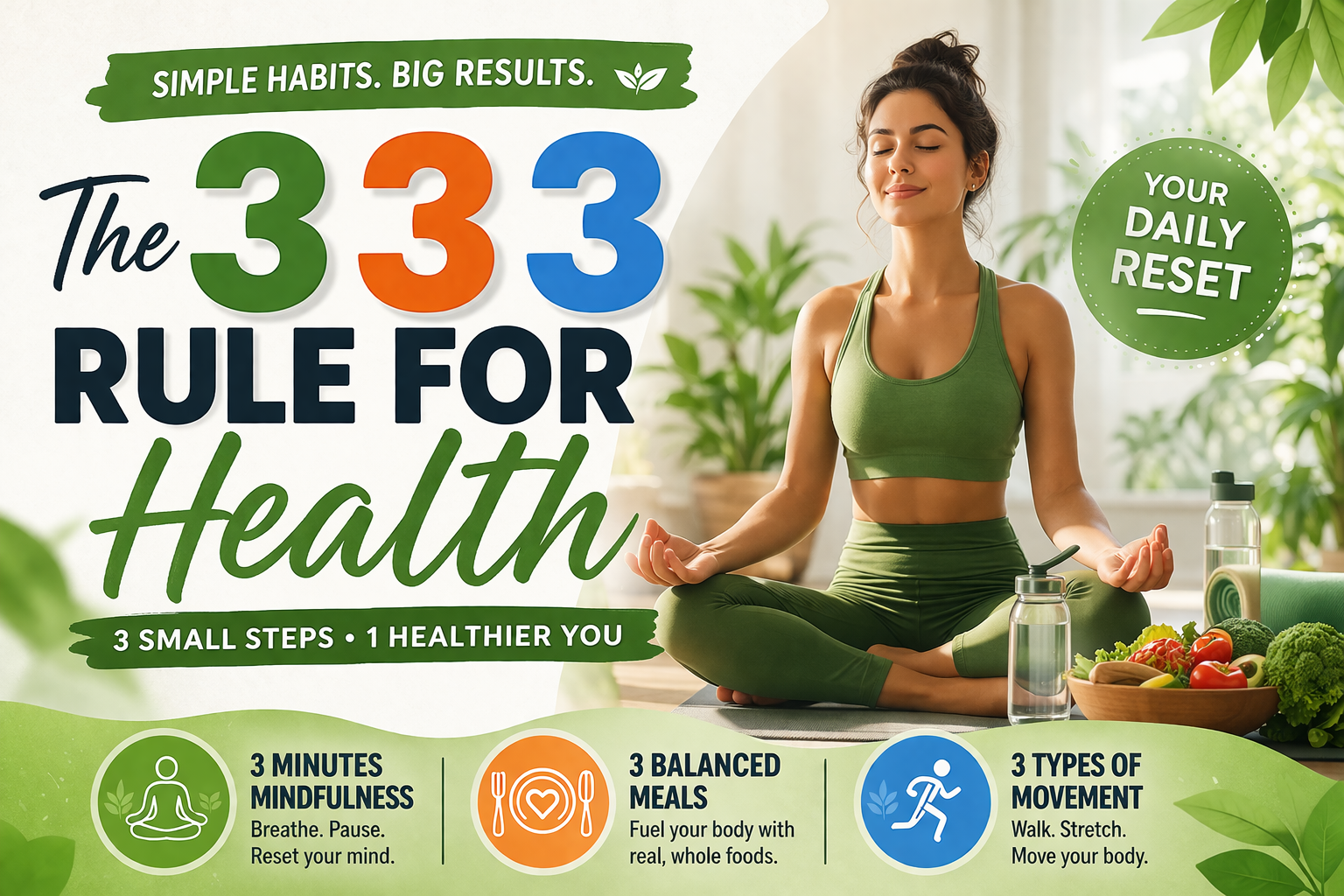
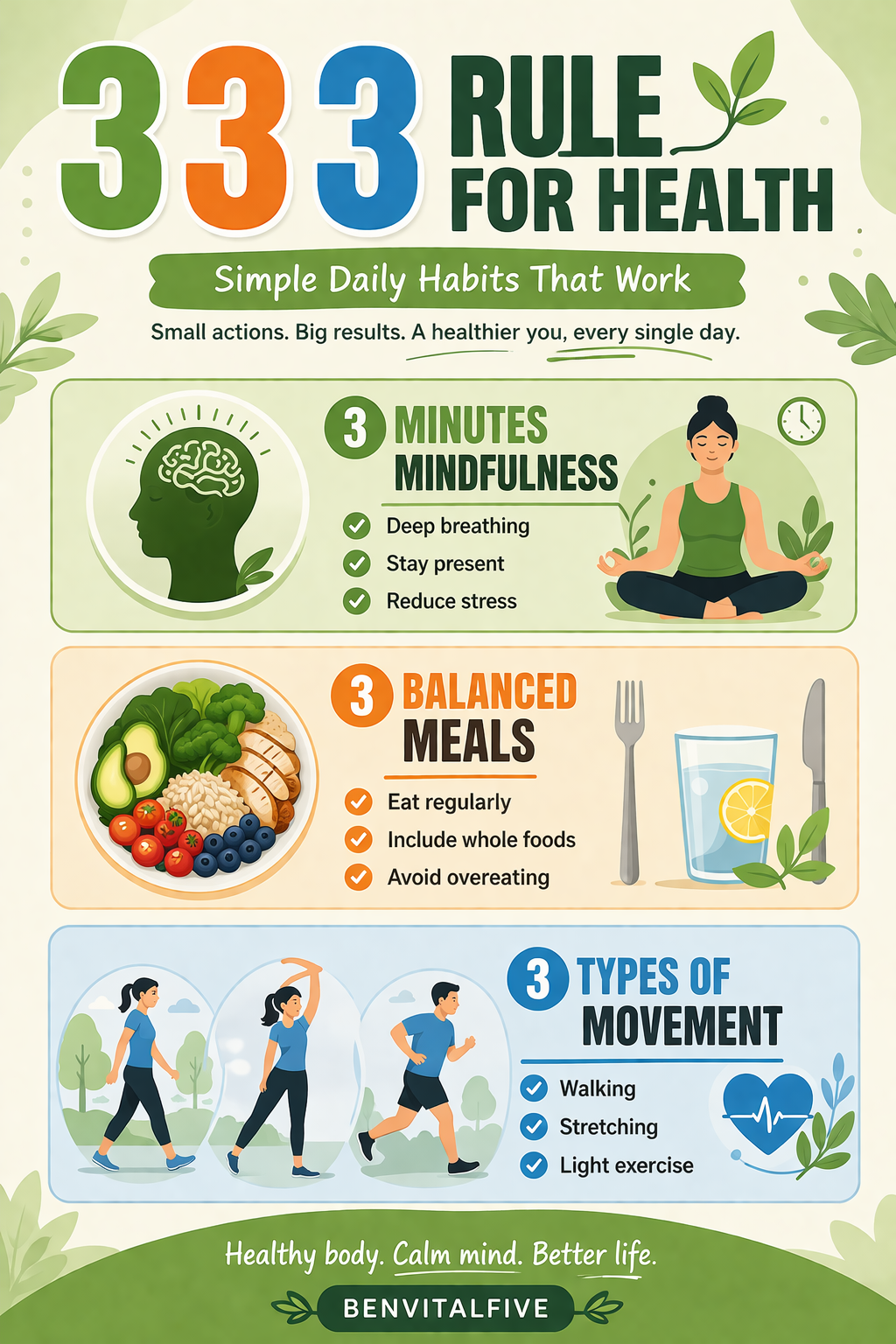
The 3 3 3 health rule is based on three simple principles:
- A 3-minute period of mindfulness or mental break
- 3 balanced meals in a day
- 3 types of physical movement
That’s it.
No long checklists. No complicated systems.
The 3 3 3 Rule for Health: When people ask this is pretty much the whole story. However, there is real value to repeating these small things every day.
The Why Simple Is Better Than Complex Anchor
To get into the details, it helps to know why this approach works.
Most people do not fail due to lack of knowing what to do.
They fail because:
- they try too much at once
- they aim for perfection
- they can’t sustain the routine
By the 3 3 3 rule you avoid all that.
It offers you just enough structure… without binding you.
That’s why an increasing number of people are wondering what is the 3 3 3 rule for health? —because it feels doable.
The First “3” — 3 Minutes of Mindfulness
This part may seem small yet make a powerful impact.
Just 3 minutes.
No long meditation sessions. No pressure to do it “ right.”
Just a short pause.
What This Looks Like in the Real World
It could be:
- sitting quietly after waking up
- sneaking in a few deep breaths throughout the day
- putting down your phone for a second
That’s it.
The goal is to slow down — just enough that your brain finds some reset.
Why It Matters
We’re constantly consuming information. Notifications, messages, scrolling… it’s non-stop.
So just a couple of minutes’ worth of quiet helps:
- reduce stress
- improve focus
- calm your thoughts
So this first step, when thinking about what is the 3 3 3 rule for health, really boils down to mental clarity.
The Second “3” — 3 Balanced Meals
Now let’s talk about food.
This is where it usually gets complicated. Diet plans, restrictions, calorie counting…
But the 3 3 3 rule simplifies things.
The Idea
- Eat regularly
- Keep meals balanced
- Don’t overthink it
No extreme dieting.
What a Balanced Meal Means (Simply)
You don’t need perfect measurements.
Just try to include:
- something new (like vegetables or fruits)
- something satiating (rice, grains or some protein)
- enough to satisfy you
That’s enough.
Why This Works
Meal skipping and random eating habits usually result in:
- low energy
- overeating later
- poor digestion
So this what the 3 3 3 rule for health is when people ask. This part is mostly about consistency in eating — not perfection.
The Third “3” — 3 Kinds of Movement
This is where most people expect something intense.
But no—it’s actually the opposite.
The 3 3 3 rule does not require you to do heavy workouts.
It simply promotes other kinds of movement.
Examples
- walking
- stretching
- light exercise
You don’t have to do all at once.
Be sure to mix things up throughout your day.
Why This Matters
Modern life is mostly sedentary.
We sit a lot. Work on screens. Stay indoors.
As a low-tech alternative to one big session at the gym, it’s better than we realize!
This is a corner stone of what’s called the 3 3 3 rule for health — keeping your body unsedentary without being pressured into activity.
How It Fits Into a Normal Day
One of the great aspects of this rule is that it doesn’t need a special routine.
It’s fit into your day without wholly rearranging it.
For example:
- morning: 3 minutes of someone being quiet
- Over the course of the day: 3 simple meals
- evening: walking or stretching
That’s it.
No strict timing. No complicated plan.
Why We Follow Through with It
That just doesn’t work, you might say: The health routines we cannot maintain.
But the 3-3-3 rule is one in particular.
It works because:
- it’s easy to remember
- it doesn’t feel like pressure
- it fits into daily life
And that’s the reason why people are searching what is the 3 3 3 rule for health? —because they want something realistic.
Common Mistakes to Avoid
Even the simplest of systems can be overengineered.
And here’s a few things to look out for:
Trying to Be Perfect
You don’t need perfect meals or precise timing.
Doing Too Much
Don’t make this a rigid regimen.
Expecting Quick Results
This works slowly—but it lasts.
A More Realistic Way to Start
Things do not always have to be planned.
Just begin with something small:
- take 3 minutes to sit quietly
- eat at least 2 times a day decent
- move your body a little
That’s enough.
Once it becomes a routine everything else comes.
Is It Backed by Science?
The rule itself is simple enough, but the ideas that underpin it are not arbitrary.
- mindfulness reduces stress
- balanced meals support energy
- regular movement improves health
Thus though the moniker “3 3 3 rule” may seem basic, the basis is strong.
Who Should Try This?
Honestly—almost anyone.
Especially if you:
- feel overwhelmed by routines
- struggle with consistency
- want something simple
It’s adaptable, so you can fit it into your routine.
So, What is the 3 3 3 Rule for Health?
This is when the answer becomes quite obvious.
What is the 3 3 3 rule for health?
It’s not a strict plan.
It’s not a complicated system.
It’s just a simple structure:
- pause for a few minutes
- eat regularly
- move your body
That’s all.
You don’t have to turn your entire life upside down in an instant.
You do not require a perfect routine.
Just start small.
Because when you truly learn that what is the 3 3 3 rule for all wellness?, you realize something important—
Doing more does not always lead to health.
Sometimes, it comes from just doing a few things … consistently.
And this is where the actual differentiation starts
What is the 3 3 3 rule for health?
The 3 3 3 health rule has 3 mindfulness minutes, 3 balanced meals and 3 movements per day.
Does the 3 3 3 rule really work?
It does work, but it revolves around simple and routine habits, rather than routines.
Can beginners follow the 3 3 3 rule?
Absolutely. It is made in a manner that is simple and easy to follow.